


Table of Contents
- Understanding FDA-Cleared Thermometer Requirements
- Infrared vs Contact Thermometers for Clinical Use
- Key Accuracy and Precision Standards for Clinical Grade Thermometers
- How to Calibrate a Medical Thermometer
- Hygiene, Disinfection, and Cross-Contamination Protocols
- Data Connectivity and EMR/EHR Integration
- Choosing Clinical Grade Thermometers for Your Setting
- Frequently Asked Questions
Last Updated: September 15, 2026
Understanding FDA-Cleared Thermometer Requirements
In the United States, a clinical grade thermometer is a medical device regulated by the FDA's medical device classification database, and the single most important thing to understand before you buy is the difference between a device that has FDA clearance and one that merely claims to be "hospital grade." This guide from Berflow Health breaks down what that clearance actually means, how to read a device label correctly, and which specifications matter in practice.
FDA clearance means the manufacturer submitted a premarket notification and the agency determined the device is substantially equivalent to a legally marketed predicate device. It is not the same as FDA approval, which applies to higher-risk device classes. For thermometers, most products fall into Class II and reach the market through the 510(k) pathway.
Here is what separates a genuinely cleared device from marketing language:
- A 510(k) clearance number, printed on the label or listed in the FDA 510(k) premarket notification database
- A clear intended-use statement covering the measurement site (oral, axillary, rectal, tympanic, or non-contact)
- A stated accuracy tolerance, not just a "fast and accurate" claim
- Labeling that names the manufacturer and a US agent or distributor
A common mistake is assuming that any thermometer sold to consumers meets clinical requirements. Many do not. Some are marketed for "wellness" or "screening" use precisely because they have not been cleared for diagnostic temperature measurement.
For home users managing a chronic condition, the practical takeaway is narrower: check for a clearance number before you trust a reading enough to act on it. Everything else in this guide builds on that foundation.
Infrared vs Contact Thermometers for Clinical Use
Infrared thermometers read emitted thermal energy from the skin or tympanic membrane, while contact thermometers rely on a digital probe held against a mucous membrane or in the axilla. Each technology has a distinct accuracy profile, and the right choice depends on your patient population and workflow.
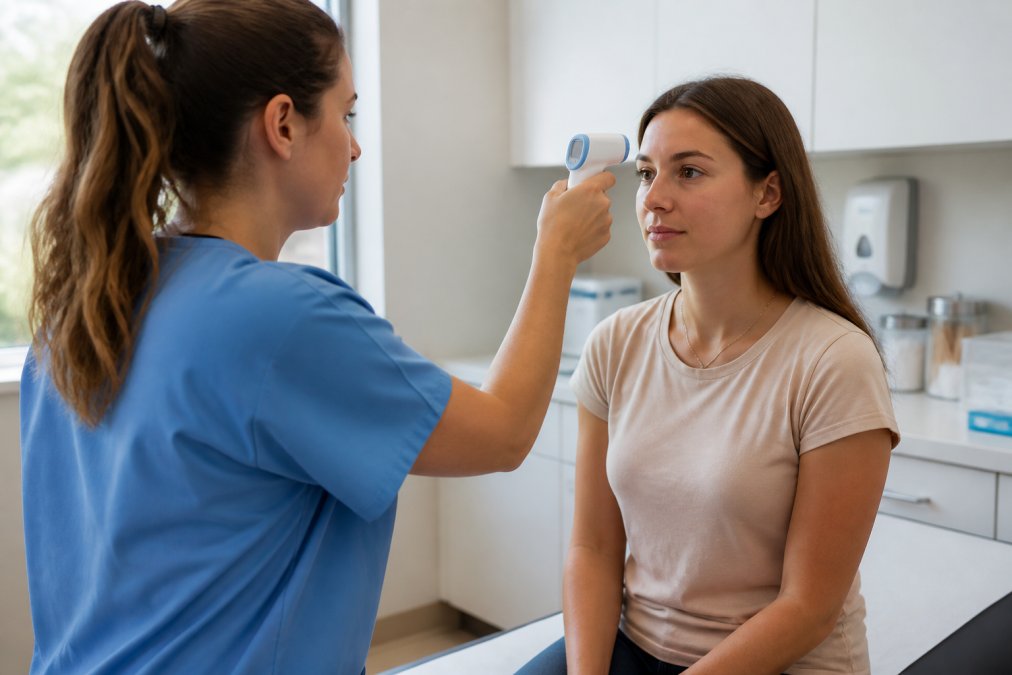
Non-contact infrared devices shine for screening and for patients who cannot tolerate a probe: infants, patients on isolation precautions, and anyone who needs a reading without waking. The trade-off is sensitivity to technique. Ambient temperature, distance from the skin, and forehead sweat all shift the result.
Contact thermometers, particularly oral and rectal digital probes, remain the reference standard for core temperature estimation in most clinical settings. Oral readings are reliable in cooperative adults and children over roughly four years old. Rectal readings stay the most accurate option for infants and for any patient where core temperature is critical.
Tympanic thermometers sit in between. They are fast, well tolerated, and widely used, but incorrect probe placement in the ear canal produces readings that look plausible and are wrong.
| Type | Best For | Key Limitation | Typical Response Time |
|---|---|---|---|
| Non-contact infrared | Screening, infants, isolation cases | Sensitive to ambient temperature and distance | 1-3 seconds |
| Tympanic | Fast triage, pediatrics | Placement errors skew readings | 1-2 seconds |
| Oral digital probe | Adults, cooperative children | Affected by recent food or drink | 10-60 seconds |
| Axillary digital probe | Neonates, general screening | Reads lower than core temperature | 30-60 seconds |
| Rectal digital probe | Infants, critical care | Not appropriate for all patients | 10-60 seconds |
What most buying guides miss is that the technology matters less than the protocol around it. A well-calibrated contact thermometer used correctly beats an infrared device used carelessly, every time.
Key Accuracy and Precision Standards for Clinical Grade Thermometers
Accuracy and precision are not the same thing, and clinical grade thermometers must satisfy both. Accuracy describes how close a reading lands to the true temperature. Precision, sometimes called repeatability, describes how closely repeated measurements of the same subject agree with each other.
The relevant benchmark for laboratory thermometry is published by ASTM International standards for thermometer calibration, which defines how reference thermometers are verified and how accuracy tolerance is expressed. Manufacturers of clinical devices typically cite their tolerance as a plus-or-minus figure across a stated measurement range, and that range matters: a device accurate at room temperature may drift at the extremes.
Three specifications to compare before purchase:
- Accuracy tolerance, stated as a range, such as ±0.2°C across a defined span
- Measurement range, ideally covering at least 34°C to 42°C for human use
- Measurement repeatability, the spread you see across consecutive readings on the same subject
Thermal drift is the quiet failure mode. A device that reads correctly in a 22°C room may read high in a warm vehicle or a cold loading bay. Clinical validation protocols account for this; consumer packaging usually does not.
How to Calibrate a Medical Thermometer
Calibration is the process of verifying that a thermometer's readings match a known reference, and every clinical device needs it on a schedule. The method depends on the device type, but the principle is identical: compare against a traceable standard and document the result. Maintaining this level of precision also requires consistent medical device power to ensure that internal sensors remain stable during every diagnostic cycle.
Total time: 20-40 minutes per device, plus documentation. Difficulty: Intermediate.
What You'll Need
- A reference thermometer with a current calibration certificate
- An ice-point bath (crushed ice and distilled water in an insulated container)
- A stable, draft-free room
- A calibration log for your facility
Step 1: Establish the Reference [Time: 10 minutes]
Build an ice-point bath and let it stabilize. Insert the reference thermometer and confirm it reads 0°C within its own stated tolerance. This becomes your baseline.
Expected result: A stable reference reading you can compare against.
Step 2: Test the Device Under Calibration [Time: 5-10 minutes]
Insert or aim the device under test at the reference bath per the manufacturer's instructions. Record the reading.
Expected result: A reading within the device's stated accuracy tolerance of the reference.
Step 3: Repeat and Record [Time: 10 minutes]
Take three readings, not one. A single reading can be a fluke. Record all three in your log with the date, operator, and reference certificate number.
Expected result: A documented record showing consistency across readings.
Step 4: Act on the Result [Time: 5 minutes]
If the device falls outside tolerance, remove it from service. Some devices allow field recalibration; others must go back to the manufacturer. Do not adjust a device unless the manufacturer's instructions permit it.
Expected result: A clear pass or fail decision, logged.
The thing nobody tells you about calibration is that the log matters as much as the procedure. In an audit, an undocumented calibration is treated the same as no calibration at all.
Hygiene, Disinfection, and Cross-Contamination Protocols
Cross-contamination is the most underrated risk in clinical thermometry, and the fix is procedural rather than technological. A thermometer that touches a mucous membrane is a potential vector, and the same device reused across patients without proper infection control steps will spread pathogens regardless of how accurate it is.
Probe covers are the first line of defense for contact devices. Single-use covers should be discarded between every patient, no exceptions, and the probe base should be wiped with a compatible disinfectant after cover removal.
For non-contact infrared devices, the risk is lower but not zero. The device never touches the patient, but it does pass between rooms and hands. Wipe the housing and sensor window per the manufacturer's disinfection compatibility guidance, and check that guidance carefully: some sensor windows are damaged by alcohol-based wipes, and a clouded window will skew readings.
A workable protocol for most facilities:
Data Connectivity and EMR/EHR Integration
Choosing Clinical Grade Thermometers for Your Setting
| Setting | Priority | Device Type to Favor |
|---|---|---|
| Home, chronic condition monitoring | Speed, hygiene, ease of use | Dual-mode non-contact infrared |
| Pediatric clinic | Tolerability, accuracy in infants | Tympanic plus rectal backup |
| Hospital ward | Calibration records, integration | Contact probe with EMR interface |
| Pharmacy resale | Regulatory clarity, margin | Cleared consumer-facing devices |
Frequently Asked Questions
What makes a thermometer 'clinical grade'?
Clinical grade thermometers meet stricter accuracy tolerances than standard retail models, typically within ±0.2°F for infrared devices and ±0.1°F for digital probes. They carry FDA clearance as medical devices, include calibration certificates, and are designed for repeated use with hygiene protocols like probe covers or non-contact sensors. The ASTM E1112 and E1965 standards define these performance requirements, ensuring measurement repeatability and reliability in healthcare settings.
How often should a clinical thermometer be calibrated?
The CDC and device manufacturers recommend calibration verification every 6 to 12 months for clinical thermometers, or after any physical drop or exposure to extreme temperatures. High-volume facilities may need quarterly checks. Use a calibrated reference thermometer in a stable water bath to compare readings at multiple points. Document each check and adjust or replace the device if readings drift beyond the accuracy tolerance stated in the manual.
Are FDA-cleared thermometers better than standard retail models?
FDA-cleared thermometers undergo clinical validation to prove accuracy within specific tolerances, while many retail thermometers are not reviewed by the FDA at all. For fever detection in vulnerable patients or clinical decision-making, FDA clearance signals the device meets medical device standards for performance and labeling. Retail models may be adequate for casual home use but often lack the calibration stability, response time, and hygiene features required in healthcare environments.
Do hospitals use infrared or contact thermometers?
Most hospitals use both, depending on the clinical scenario. Non-contact infrared thermometers are common for triage and rapid screening because they reduce cross-contamination and take readings in 1 to 3 seconds. Contact digital probes, including oral, axillary, and rectal types, remain the standard for precise core temperature measurement in critical care. Tympanic thermometers offer a middle ground with good accuracy and speed when used correctly.
