


Table of Contents
- What Baby Health Monitoring Systems Do
- Comparison Table: Key Features and Specifications
- What Is a Normal Oxygen Level for Baby and How Monitors Track It
- Best Practices for Home Diagnostic Monitoring
- Privacy, Data Security, and Long-Term Data Protection
- Troubleshooting False Alarms and Signal Interference
- Which System Should You Choose
- Frequently Asked Questions
Last Updated: September 18, 2026
What Baby Health Monitoring Systems Do
Baby health monitoring systems track vital signs and movement patterns to help parents and healthcare providers watch over infant health continuously. These devices measure oxygen saturation through pulse oximetry, detect breathing patterns, monitor heart rate, and often include temperature sensors. Some systems add video monitoring with night vision and two-way audio capabilities.
The core function is real-time alerts. If oxygen levels drop, breathing stops, or movement becomes abnormal, the system sends immediate notifications to a parent's smartphone or a dedicated parent unit. This cardiorespiratory monitoring provides peace of mind for families with high-risk infants or those recovering from illness.
At Berflow Health, we understand that families need reliable, clinically accurate tools for home diagnostic monitoring. Our multi-parameter patient monitors allow parents and caregivers to track vital signs with confidence in any environment.

Most systems operate on a closed-loop architecture: sensors detect biometric data, the system analyzes it in real-time, and alerts trigger if readings fall outside safe parameters. Better systems include trend data storage so you can review patterns over hours or days, not just react to individual readings.
Comparison Table: Key Features and Specifications
| Feature | G3C Monitor | G3D Monitor | G3D10 Monitor | G3E Monitor | G3F Monitor |
|---|---|---|---|---|---|
| Screen Size | 10.4" LCD | 12.1" LCD | 10.4" LCD | 7" LCD | 10.4" LCD |
| Suitable For | Adults, pediatrics, neonates | Adults, pediatrics, neonates | Adults, pediatrics, neonates | Adults, pediatrics, neonates | Adults, pediatrics, neonates |
| Data Storage | 360 hours trend | 360 hours trend | 360 hours trend | 360 hours trend | 360 hours trend |
| Networking | WAN + HL7 compatible | WAN + HL7 compatible | WAN + HL7 compatible | WAN + HL7 compatible | WAN + HL7 compatible |
| Alarm Function | Audible + visual | Audible + visual | Audible + visual | Audible + visual | Audible + visual |
| Best For | Hospitals, ICU | Hospitals, ICU | Clinics, emergency | Outpatient clinics | General healthcare |
All Berflow Health multi-parameter monitors include ST-segment analysis, arrhythmia detection, and support for specialized testing like nasal tube respiration monitoring. Each model features an "auto-current drift balanced system" that ensures accuracy, along with unique patents for impedance RESP and ECG waveform stability during electrosurgical procedures.
The choice between models depends on your setting. Larger screens (G3D at 12.1") work best in high-activity hospital units where staff need to scan data quickly from a distance. Compact models (G3E at 7") suit portable or space-constrained clinics. Mid-range options (G3C, G3D10, G3F) balance visibility with flexibility.
What Is a Normal Oxygen Level for Baby and How Monitors Track It
A normal oxygen saturation level for a healthy baby is between 95 and 100 percent. Readings below 90 percent warrant immediate medical attention. Newborns and premature infants may have slightly lower baseline readings (88-95 percent) as their lungs mature, but this varies by individual health status and should always be confirmed with a pediatrician.
Pulse oximetry measures oxygen saturation non-invasively by shining light through the skin and detecting how much oxygen-carrying hemoglobin is present in blood. The sensor clips to a finger, toe, or in some cases wraps around the foot. It displays readings within seconds and trends over time.
Many parents worry about false positives. A baby moving suddenly, poor sensor placement, or temporary circulation changes can trigger brief dips that aren't clinically significant. This is where trend data storage matters. Systems that track readings over 360 hours let you see patterns: a single dip to 92 percent looks different from consistent readings below 90 percent.
Berflow Health's multi-parameter monitors combine pulse oximetry with other vital sign tracking. The G3C, G3D, G3D10, G3E, and G3F models all measure oxygen saturation continuously alongside heart rate and respiratory rate, giving a complete picture of cardiorespiratory health rather than oxygen levels alone.
Best Practices for Home Diagnostic Monitoring
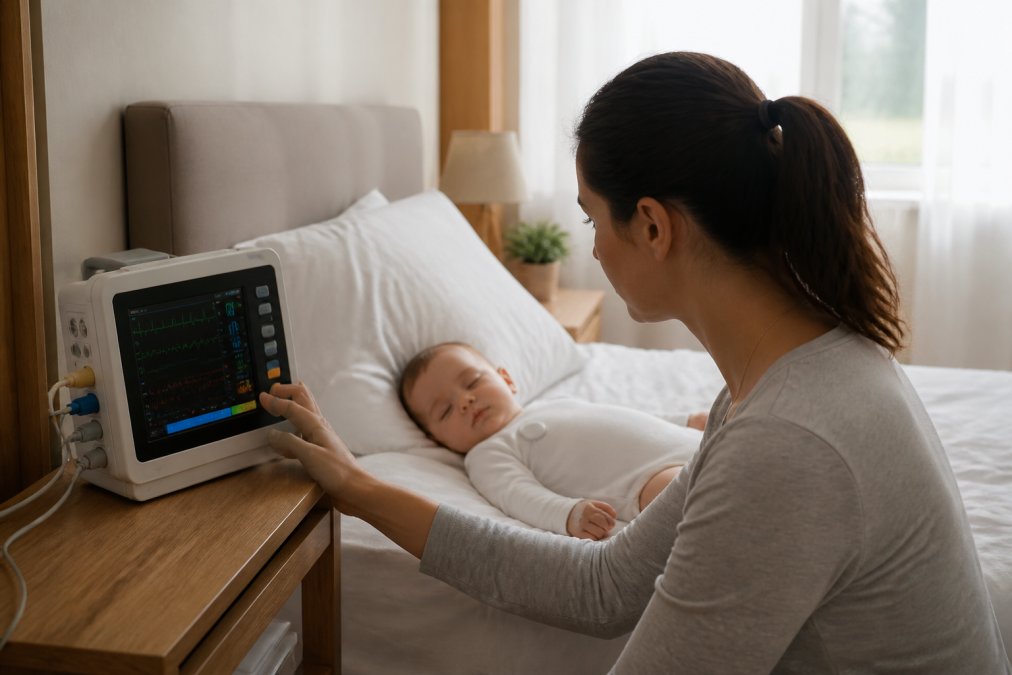
Successful home diagnostic monitoring starts with proper sensor placement. For infants, place the pulse oximetry sensor on the foot or big toe where blood flow is strong. Secure it snugly but not so tight that it restricts circulation. Check placement every few hours because babies move constantly.
Keep the parent unit or smartphone within reliable signal range. Most systems use WiFi or Bluetooth, and signal interference from other smart home devices can cause false alerts. Position the parent unit on a nightstand or wear it during the day so alerts reach you immediately.
Establish a baseline. Record your baby's normal oxygen saturation, heart rate, and breathing pattern when healthy. This reference point helps you recognize abnormal readings. A temporary dip to 93 percent might be normal for your baby but concerning for another infant.
Clean sensors regularly. Dust or skin oils reduce light transmission and cause inaccurate readings. Most sensors clean with a soft, dry cloth. Never submerge them in water unless the manufacturer specifies waterproof design.
G3C Multi-Parameter Patient Monitor →
Set alarm thresholds appropriately. Too-sensitive alarms (set at 95 percent) trigger constantly and cause alarm fatigue. Work with your pediatrician to set thresholds that catch real problems without false alarms. Many families use 90 percent as the lower threshold for healthy infants.
Record trends in a simple log or app. Note the time, readings, and any symptoms (fever, cough, feeding difficulty). This data helps your pediatrician spot patterns you might miss and informs treatment decisions if problems develop.
Privacy, Data Security, and Long-Term Data Protection
Data security is where many home monitoring systems fall short. Your baby's heart rate, oxygen levels, and breathing patterns are sensitive health information. Once stored in the cloud, this data becomes a long-term liability if the company's security practices are weak.
Berflow Health's multi-parameter monitors support both wired and wireless networking with HL7 system compatibility, allowing secure integration with clinical electronic health records. The devices themselves don't store data indefinitely on a cloud service; instead, trend data is retained locally on the monitor for 360 hours (15 days), and data syncs to authorized healthcare systems using encrypted protocols.
Understand where your data lives. Some systems transmit every reading to a cloud server operated by the manufacturer. Others store data locally and only sync when you choose. Local storage is generally safer because fewer companies have access to your information.
Check encryption standards.
Troubleshooting False Alarms and Signal Interference
False alarms are the most common complaint with home monitoring systems. A baby rolls over, the sensor shifts, or WiFi drops briefly, and the alert screams at 3 a.m. Understanding the cause reduces panic and prevents unnecessary hospital visits.
False alarm fatigue is real and dangerous. Parents who've experienced dozens of false alarms sometimes ignore genuine alerts. If your system triggers alarms constantly, work with your pediatrician to adjust thresholds or consider a different device. A reliable system that alerts rarely is far better than a sensitive system that cries wolf.
Which System Should You Choose
For most families, the choice depends on setting and technical comfort. Hospital and clinic environments need strong, networked systems that integrate with electronic health records. Home use requires simpler setup, reliable WiFi connectivity, and clear alerts.
Choose based on these criteria:
- Hospital ICU/CCU: G3D (largest screen, full feature set)
- Operating room or emergency department: G3C or G3F (proven reliability during electrosurgery, portable)
- Outpatient clinic: G3E (compact, easy transport between rooms)
- Neonatal or pediatric unit: Any model (all support neonates with specialized nasal tube respiration testing)
Frequently Asked Questions
What is a normal oxygen level for a baby?
A normal oxygen saturation level for healthy infants is between 95% and 100%. Levels below 90% warrant immediate medical attention. Pulse oximetry sensors measure oxygen saturation by detecting light absorption through the skin, providing real-time alerts when readings fall outside safe ranges. Multi-parameter patient monitors like the G3C, G3D, and G3E offer continuous oxygen tracking alongside other vital signs, helping parents and caregivers catch concerning changes instantly.
Are baby health monitoring systems worth the investment?
For families with high-risk infants, premature babies, or those with respiratory conditions, monitoring systems can provide peace of mind and early warning capability. They track heart rate, blood pressure, oxygen saturation, and respiratory rate in real-time. The investment depends on your situation: monitors like the G3D with its 12.1-inch display and advanced alarm functions are suitable for comprehensive oversight, while smaller systems work for basic tracking. Consider whether continuous biometric tracking aligns with your medical needs.
What features should I look for in a baby health monitor?
Prioritize pulse oximetry accuracy, real-time alerts with adjustable sensitivity thresholds, and movement detection to capture breathing patterns. Check for data storage capacity (360-hour trend data is standard), encryption standards for cloud storage, and compatibility with your home network. Multi-parameter monitors should support HL7 system integration if you use electronic health records. Battery life, portability, and a user-friendly interface matter for daily use. Verify the device is suitable for neonates and pediatric patients specifically.
How do I set up a home diagnostic monitoring system correctly?
Start by reading the manufacturer's setup guide thoroughly, most monitors support 15 languages and include intuitive interfaces. Place the monitor on a stable surface near the baby, ensure proper sensor placement for accurate readings, and test all alarm functions before relying on them. Connect to your home network securely using strong passwords. Configure alert thresholds based on your baby's baseline vital signs (normal ranges vary by age). Keep firmware updated to maintain security and fix false positive issues. Store the device away from electromagnetic interference sources.
